Hey folks, Dave Saunders here—your trusted pest control specialist with over 20 years of real-world experience dealing with household invaders across the US. From humid Florida kitchens to dry California garages, I’ve seen just about every pest problem you can imagine. On this blog, I focus on giving you practical, effective solutions—especially ones that don’t involve harsh chemicals.
Today, we’re talking about one of the most powerful natural tools in the fight against roaches and ants: food-grade diatomaceous earth (often called DE). When used correctly, it can be a game-changer. But here’s the catch—many people use it wrong and then say “it doesn’t work.” In this guide, I’ll show you exactly how to use food-grade diatomaceous earth the right way so you get real, lasting results.
What Is Food-Grade Diatomaceous Earth and Why It Works
Food-grade diatomaceous earth is a fine powder made from the fossilized remains of ancient aquatic organisms called diatoms. Under a microscope, these particles have sharp, jagged edges. When roaches or ants crawl over DE, these microscopic edges scratch their exoskeleton and absorb the oils and moisture from their bodies. As a result, the insects dehydrate and die within 24–72 hours.
Important: Only use food-grade diatomaceous earth. The industrial grade (pool grade) is chemically treated and dangerous to breathe or use around your home and pets.
From my experience helping hundreds of homeowners, DE works especially well against German cockroaches, American cockroaches, carpenter ants, and sugar ants. It’s safe to use around children and pets when applied correctly, and it leaves no toxic residue.
How to Apply Diatomaceous Earth Correctly (Step-by-Step)
Here’s the exact method I recommend to my clients:
-
Choose the right product Make sure it’s clearly labeled “Food Grade Diatomaceous Earth.” Popular reliable brands in the US include Harris, Safer Brand, and generic food-grade DE from Amazon.
-
Prepare the area
- Vacuum and clean the surfaces thoroughly (especially cracks, corners, and behind appliances).
- Make sure the area is completely dry — DE works only when dry.
-
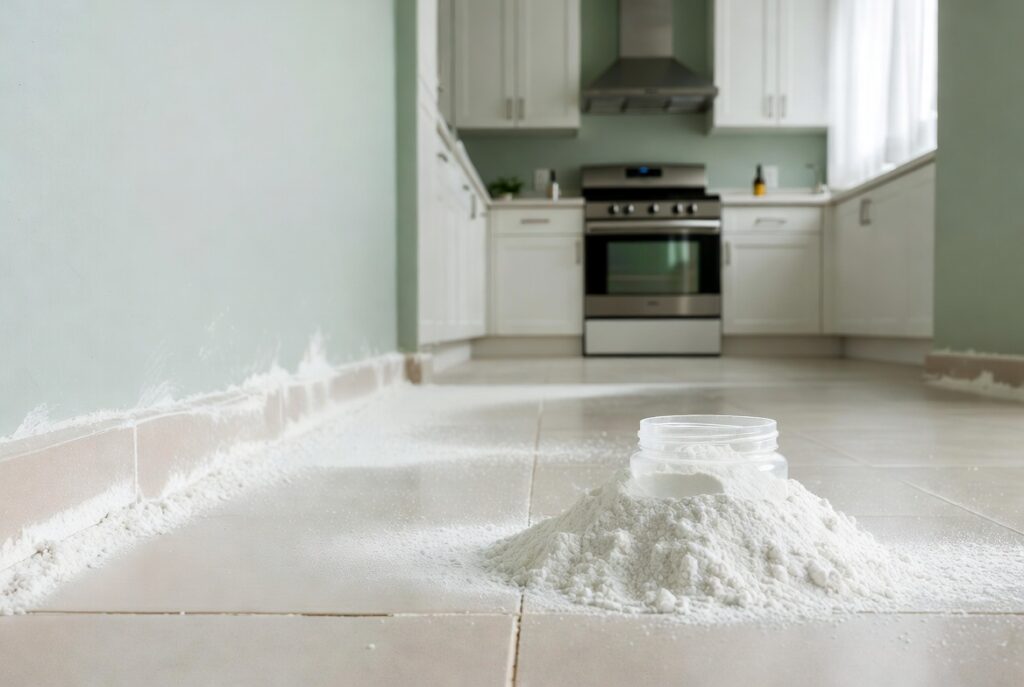
Apply a thin layer Use a duster, shaker bottle, or small spoon to apply a very thin, almost invisible layer of DE in the following places:
- Along baseboards and where walls meet the floor
- Behind and under refrigerators, stoves, and dishwashers
- Inside cabinets and drawers (especially where food is stored)
- Around plumbing pipes and sink areas
- In cracks and crevices where you’ve seen roaches or ants
Pro tip: Less is more. A thick pile of DE actually reduces effectiveness because insects can walk over it without touching the sharp edges.
-
Reapply when necessary
- After cleaning or mopping
- After high humidity or rain (DE becomes ineffective when wet)
- Every 7–10 days in high-activity areas
-
Combine with bait for faster results For best results, use DE as a barrier and place borax or commercial baits in areas where insects travel. DE kills on contact, while baits help eliminate the colony.
Comparison: Diatomaceous Earth vs Other Natural Methods
Here’s a quick comparison based on my real-world testing:
| Method | Speed of Kill | Colony Elimination | Safety for Pets/Kids | Reapplication Needed | Best Used For |
|---|---|---|---|---|---|
| Food-Grade Diatomaceous Earth | 1–3 days | Moderate | Very High | Every 7–10 days | Barrier & Contact Kill |
| Borax + Sugar Bait | 3–14 days | High | Medium | Every 7 days | Colony Elimination |
| Vinegar Spray | Immediate | Low | Very High | Daily | Trail Disruption |
| Essential Oil Spray | 1–2 days | Low | High | Every 2–3 days | Repellent |
| Sticky Traps | Immediate | Low | Very High | Every 7 days | Monitoring |
My recommendation: Use DE as your main barrier + borax bait as your colony killer. This combination gives the fastest and most complete results.
Safety Tips When Using Diatomaceous Earth
- Always wear a mask when applying large amounts to avoid breathing in the fine dust.
- Keep pets and children away from the area while applying.
- Use only in dry areas — it stops working when wet.
- Vacuum up old DE before reapplying to prevent buildup.
Prevention Tips to Keep Roaches and Ants Away
- Store all food in airtight containers.
- Fix any leaks and reduce moisture.
- Clean up crumbs and spills immediately.
- Seal cracks and gaps around pipes and baseboards.
- Take out the trash daily.
Final Thoughts
Food-grade diatomaceous earth is one of the most effective, affordable, and safe tools you can use against roaches and ants. When applied correctly as a thin barrier and combined with good sanitation and bait, it can dramatically reduce or even eliminate infestations without harsh chemicals.
Have you tried diatomaceous earth before? What worked and what didn’t? Drop your experience in the comments below — I read every one and often update my advice based on real results from readers like you.
Stay pest-free, friends!
Dave Saunders
Welcome to my pest control blog! I’m Dave Saunders, a seasoned pest management specialist with over 20 years of experience helping homeowners and businesses across the United States. My journey began in the sunny landscapes of California, where I honed my skills tackling a wide range of pests, from ants to spiders. Over the years, I’ve expanded my expertise to Florida and numerous other states, adapting to diverse climates and pest challenges.
With a deep passion for eco-friendly solutions, I’ve dedicated my career to providing practical, safe, and effective pest control methods. Whether it’s crafting natural repellents or sharing integrated pest management strategies, my goal is to empower you with the knowledge to maintain a pest-free home. Join me as I share insights from two decades in the field!
